If your car or truck is slipping, refusing to engage, shifting harshly, or showing signs of internal transmission trouble, call (931) 473-5302. Tell us the year, make, model, and symptoms. We can talk about the next step without assuming a rebuild is the answer.
When Does a Transmission Need Rebuilding?
A transmission has many parts working together. Depending on the design, these may include clutch packs, bands, seals, bearings, planetary gearsets, hydraulic circuits, a valve body, and electronically controlled solenoids. Wear or damage in one area can affect how the whole unit operates.
Some problems can be addressed with a targeted Transmission Repair. Others involve enough internal wear or damage that opening and rebuilding the transmission may be the appropriate option. Still others are better evaluated for Transmission Replacement. The decision begins with understanding the fault, the vehicle's condition, and what repair options are available.
Chuck McCracken taught Bo, "Don't tell somebody they need a transmission unless you're sure they need a transmission." That approach still matters. We want to understand the problem before recommending the kind of major work that rebuilding involves. Learn more about Transmission Diagnostics.
What In-House Transmission Rebuilding Means
Inspection and Disassembly
When rebuilding is the agreed repair path, the transmission is removed as needed and disassembled so its internal condition can be evaluated. A rebuild is more than changing the fluid or replacing one external component. It involves looking at the parts and systems that allow the unit to transmit power and shift correctly.
Internal Parts and Wear
The components involved differ by transmission. Friction materials, seals, bearings, hard parts, hydraulic components, and other internal pieces may need attention depending on what inspection reveals. Rebuilding does not mean every part is automatically replaced; it means the repair is based on the unit's condition and the work required for that application.
Valve Bodies, Solenoids, and Electronic Controls
Many newer automatics depend on hydraulic circuits and electronic commands working together. A valve-body concern, pressure-control problem, or solenoid-related fault can resemble internal mechanical failure. The rebuild plan needs to account for the actual findings and the transmission's design, rather than treating every shift complaint as the same issue.
Torque Converter and Related Systems
On many conventional automatic transmissions, the torque converter is part of the overall repair conversation. Converter replacement may be appropriate depending on the failure and application. We do not rebuild torque converters in-house. See Torque Converter Problems & Replacement for more information. Other associated systems may also need attention based on what failed, but no single checklist applies to every vehicle.
Reinstallation and Evaluation
After rebuilding and installation, the team checks the vehicle's operation. Jeff Kemper's work includes removal, installation, scanning, and test drives. Depending on the transmission, further checks or vehicle-specific setup may be appropriate. We do not promise a fixed turnaround time or suggest that every transmission follows an identical rebuild procedure.
Modern Automatic Transmissions Require Specific Knowledge
Transmission designs have changed considerably since Chuck started the business. Older automatics often have fewer forward gears and different control systems. Modern six-, eight-, and ten-speed transmissions may use more complex hydraulic strategies, electronic controls, and vehicle-specific components. That changes both diagnosis and rebuilding.
Ford F-150 applications, for example, have used 6R80 six-speed and 10R80 ten-speed automatic families. Chevrolet Silverado and GMC Sierra pickups have used units such as the 6L80, 8L90, and 10L80 depending on year and configuration. Certain Ram trucks use transmissions including the 68RFE or Aisin AS69RC, while some Ram 1500 applications use eight-speed ZF-family designs.
These codes are useful when a vehicle owner or another shop calls about a specific unit. They describe transmission families found in the market, not a guarantee that we rebuild every example. Even two trucks with the same nameplate may have different transmissions, engines, controls, and repair requirements. Explore Automatic Transmission Repair for more on those differences.
Asian Vehicles and CVT Considerations
We also work on many Nissan, Honda, Mazda, and Mitsubishi vehicles, depending on the model, year, and transmission. Depending on year and configuration, certain Nissan Altima, Rogue, Sentra, and Versa models use Jatco CVT families identified by codes such as JF011E (RE0F10A), JF015E (RE0F11A), and JF016E (RE0F10D).
A continuously variable transmission is not built like a conventional stepped automatic. Its design, failure modes, and available repair options may differ substantially. Some CVT transmissions may not be suitable for an in-house rebuild, so we confirm the exact vehicle and transmission before discussing what is possible. Learn more about CVT Transmission Repair.
We work on many domestic and Asian vehicles, including Ford, Chevrolet, GMC, Dodge, Ram, Nissan, Honda, Mazda, and Mitsubishi, but not every year or transmission. We do not service European vehicles. Please call with the exact vehicle details to confirm the shop's scope.
A Family That Still Does the Work
The knowledge behind this shop runs through generations. Charlie Cooper helped teach Chuck McCracken transmission work. Chuck opened his Smithville business in 1976 and moved it to McMinnville in 1979. Bo grew up around the shop and joined the business in 1997.
When Chuck became seriously ill in 2002, Bo took over daily operations. He sometimes called his father at the hospital to work through difficult transmission questions. Chuck died in 2004, but the way he taught Bo to investigate a problem before recommending major work remains part of the shop's approach.
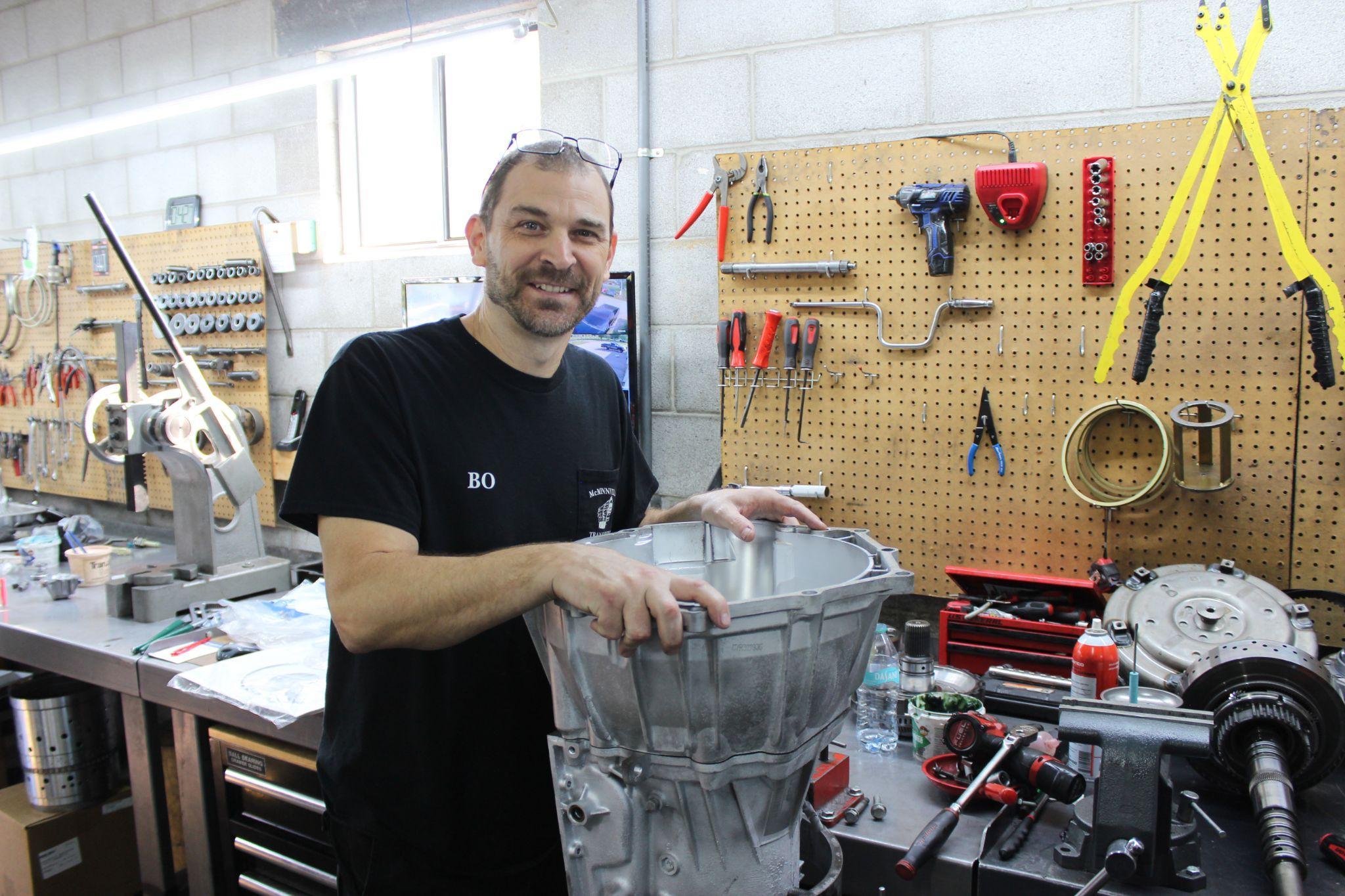
Today, Bo diagnoses and rebuilds transmissions himself. His cousin Jeff Kemper brings more than 20 years of experience in removal, installation, scanning, and test drives. Bo's nephew Seth Cantrell is learning to rebuild newer six-, eight-, and ten-speed units under Bo's guidance. Connie McCracken helps customers in the front office, continuing the family's direct involvement in the business.
This is why in-house rebuilding matters to us. The people discussing the problem are close to the people doing the work. Learn more about the family on our About Us / Our Story page.
Rebuild or Replace? Making the Right Decision for Your Vehicle
Rebuilding keeps the focus on the existing transmission and its condition. Replacement involves installing another unit. Neither option is automatically the best choice for every vehicle. The decision may depend on the damage, availability of appropriate components or units, vehicle condition, and the work involved.
Bo can explain the repair options that apply after the transmission problem has been evaluated. Our Transmission Replacement page covers that alternative in more detail. If the problem has not yet been identified, begin with Transmission Diagnostics.
Work Trucks and Referrals From Other Repair Shops
Transmission problems can interrupt a workday, especially for trucks that carry tools, materials, or equipment. We speak with owners of appropriate working vehicles about the transmission involved and the available repair path. Read about Fleet & Work Truck Transmission Repair.
We also work with general automotive shops that need a transmission specialist for a customer's vehicle. Transmission Repair for Auto Repair Shops explains how referring shops can contact us. Knowing the vehicle details and any prior findings helps start a useful conversation.
What About Warranty Coverage?
Qualifying work may include a 24-month/24,000-mile warranty, subject to the actual written terms for the job. Coverage is not automatic for every repair, component, or vehicle. Ask about the terms that apply to your specific work and see Transmission Warranty for more information.
Talk With Bo's Team About Transmission Rebuilding
McMinnville Transmission is located at 1703 S. Chancery St., McMinnville, TN 37110. We serve customers from McMinnville and Warren County, with drivers also contacting us from nearby Smithville, Sparta, Woodbury, and Manchester.
Call (931) 473-5302 and describe the symptoms, any previous diagnosis, and the vehicle's year, make, and model. Connie and the team can help you discuss the next step. Visit Contact & Directions for the address and route, or explore Transmission Services for the broader range of work we perform.