At McMinnville Transmission, we help drivers identify problems involving the components that transfer power from the transmission to the wheels. Our drivetrain services include differential and rear-end repair, CV axles and CV joints, and U-joints and driveline repair.
Owner Bo McCracken personally diagnoses and rebuilds transmissions, continuing a family trade that dates back to 1976. The shop has served McMinnville since 1979, and our approach to drivetrain problems begins with understanding what's actually causing the symptom.
If your car, truck, or SUV is making an unusual noise, vibrating, or behaving differently when you accelerate, call (931) 473-5302 to discuss your vehicle and the appropriate next step.
What Is the Drivetrain?
The drivetrain is the group of components that delivers power from the transmission to the vehicle's driving wheels. Depending on the vehicle, that can include driveshafts, differentials, axle shafts, CV joints, U-joints, and other connecting components.
On a rear-wheel-drive truck, for example, power typically travels from the transmission through a driveshaft to the rear differential. The differential then transfers power through the axle shafts to the wheels.
On many front-wheel-drive cars, power passes through a transaxle assembly and then through CV axle shafts to the front wheels. Four-wheel-drive and all-wheel-drive vehicles can have additional components, including transfer cases, front and rear differentials, and multiple driveshafts.
Because these parts are connected, a problem in one area can sometimes be felt elsewhere in the vehicle. Understanding how the system works helps narrow down the cause rather than replacing components based on symptoms alone.
Our Drivetrain Repair Services
Differential & Rear-End Repair
Differential & Rear-End Repair
The differential allows the driving wheels to rotate at different speeds when the vehicle turns while transferring power through the axle assembly. In rear-wheel-drive trucks, the rear differential is a major part of the drivetrain. Some vehicles also have front differentials.
A differential problem may cause whining, humming, grinding, or clunking noises. Depending on the failure, the noise may change during acceleration, deceleration, or turns. Fluid leaks and internal bearing or gear wear can also affect differential operation.
Not every rear-end noise means the ring and pinion gears have failed. Bearings, axle components, and other connected parts may be responsible, which is why the source should be identified before recommending repairs.
Visit our Differential & Rear-End Repair page to learn about common symptoms, diagnosis, and repair options.
CV Axles & CV Joints
Constant velocity joints, commonly called CV joints, allow axle shafts to transfer power while accommodating movement from steering and suspension travel. They're especially common on front-wheel-drive vehicles, but they're also used in many all-wheel-drive and independent-suspension designs.
One familiar symptom of an outer CV joint problem is clicking or popping during turns, particularly while accelerating. Other CV axle concerns may cause vibration, grease leakage from a damaged boot, or unusual movement in the drivetrain.
A torn CV boot can allow grease to escape and contaminants to enter the joint. If the problem is caught early, the available options may differ from those for a joint that has already developed significant wear.
Visit our CV Axles & CV Joints page to learn more about symptoms and repair considerations.
U-Joints & Driveline Repair
Universal joints, or U-joints, are used in many driveshaft assemblies to accommodate changes in angle while transferring rotational power. They're particularly familiar to owners of rear-wheel-drive and four-wheel-drive trucks.
When a U-joint wears, drivers may notice a clunk when shifting between drive and reverse, a vibration during acceleration, or other unusual driveline noises. A worn joint can also place stress on surrounding components.
Not every vibration is caused by a U-joint. Driveshaft balance, support bearings where equipped, differential problems, and other components can create similar symptoms.
Visit our U-Joints & Driveline Repair page for a closer look at driveshaft and universal joint concerns.
Common Signs of Drivetrain Problems
Clunking When Shifting Into Drive or Reverse
A clunk when the vehicle begins moving can sometimes indicate excess movement or wear in a drivetrain component. Depending on the vehicle, possible causes include U-joints, differential components, mounts, or other connected parts.
However, the sound doesn't automatically mean the transmission has failed. The location and timing of the clunk are important details when narrowing down the source.
Vibration During Acceleration
A vibration that appears or becomes stronger under acceleration may involve a driveshaft, CV axle, U-joint, or another drivetrain component. Some vibrations are felt through the floor or seat, while others may be noticeable through the steering wheel.
The speed at which the vibration occurs and whether it changes under load can help guide the evaluation. Tires, wheels, engine operation, and other vehicle systems can also cause vibration.
Clicking or Popping When Turning
Repeated clicking during turns is often associated with worn outer CV joints, particularly on front-wheel-drive vehicles. The sound may be more noticeable during tight turns when power is applied.
Other steering, suspension, or drivetrain problems can also produce noises during turns. The symptom should be evaluated before replacing an axle assembly.
Humming, Whining, or Grinding
A humming or whining noise that changes with road speed can sometimes involve differential bearings, gear wear, or other rotating drivetrain components. A grinding sound may indicate a more serious mechanical concern.
Wheel bearings, tires, and transmission components can create similar noises. Determining where the sound originates is important before deciding on a repair.
Grease or Fluid Leaks
Grease around a CV axle boot can indicate a damaged boot or joint concern. Fluid around a differential housing or axle seal may indicate a different type of leak.
The location and type of fluid or grease matter, but appearances alone may not identify the exact source. An inspection helps determine whether the problem involves a seal, boot, gasket, or another component.
Is It the Transmission or the Drivetrain?
This is one of the most important questions when a vehicle develops a new vibration, noise, or hesitation.
The transmission and drivetrain work together, but they have different jobs. The transmission manages gear ratios and power delivery, while drivetrain components carry that power to the wheels.
A transmission problem may cause slipping, delayed engagement, or abnormal shifting. A driveline problem may cause vibration, clunking, clicking, or noise under certain driving conditions. However, these symptoms can overlap, and neither list is an absolute rule.
A driver might believe the transmission is slipping when a driveline component is causing unusual movement or noise. Another driver may suspect a driveshaft when the actual problem involves the transmission or transfer case.
At McMinnville Transmission, we believe the repair decision should follow the diagnosis. Our Transmission Diagnostics page explains why identifying the source matters before recommending major work.
Drivetrain Problems in Four-Wheel-Drive and All-Wheel-Drive Vehicles
Four-wheel-drive and all-wheel-drive systems introduce additional components that can complicate diagnosis. Depending on the design, a vehicle may have front and rear differentials, multiple axle shafts, driveshafts, and a transfer case or other power-distribution unit.
A vibration in a four-wheel-drive truck may involve the front or rear driveshaft, a U-joint, or another rotating component. A grinding or engagement problem may involve the transfer case rather than the transmission itself.
Some vehicles also have electronically controlled systems that affect how power is distributed. A warning light or difficulty engaging four-wheel drive doesn't automatically mean the transfer case needs replacement.
For problems involving four-wheel-drive engagement, grinding, or suspected transfer case damage, visit our Transfer Case Repair, Rebuild & Replacement page.
Drivetrain Repair for Cars, Trucks, and SUVs
McMinnville Transmission works on many domestic and Asian vehicles, including appropriate Ford, Chevrolet, GMC, Dodge, Ram, Nissan, Honda, Mazda, and Mitsubishi models.
Rear-wheel-drive and four-wheel-drive trucks such as certain Ford F-150, Chevrolet Silverado, GMC Sierra, and Ram models may have driveshafts, U-joints, differentials, and other drivetrain components that require attention.
Front-wheel-drive cars and crossovers such as certain Nissan Altima, Honda Accord, Honda Civic, Mazda3, and Mitsubishi models commonly use CV axle shafts. The exact drivetrain arrangement varies by model, year, and configuration.
We don't assume that every vehicle from a particular manufacturer has the same components or repair requirements. We do not service European vehicles, and not every domestic or Asian drivetrain system is one we handle.
Call with your year, make, model, and symptoms so we can confirm whether your vehicle is within our service scope.
Why Drivetrain Diagnosis Matters
A drivetrain noise can travel through the vehicle, making it difficult to tell exactly where it began. A worn U-joint may sound like a rear-end problem, while a differential bearing may create a vibration or hum that seems to come from the transmission.
Depending on the vehicle and complaint, evaluating the problem may involve discussing when the symptom occurs, inspecting relevant drivetrain components, checking for visible leaks or wear, and considering additional testing or a road test when appropriate.
The goal is to identify the component responsible rather than replacing parts because they are nearby or commonly associated with the symptom.
That approach is especially important when the proposed repair involves major drivetrain components. Our Transmission Repair services are available for qualifying transmission problems, but a drivetrain concern should not automatically become a transmission repair.
Generations of Transmission and Drivetrain Experience
McMinnville Transmission's history began with Charlie Cooper teaching Chuck McCracken the transmission trade. Chuck opened his shop in Smithville in 1976 and moved the business to McMinnville in 1979.
Chuck's son Bo joined the shop in 1997 and took over daily operations when Chuck became seriously ill in 2002. Even while Chuck was in the hospital, Bo sometimes called him to talk through difficult transmission problems. Chuck passed away in 2004, but his approach to diagnosing problems continued through Bo.
One of Chuck's lessons was, “Don't tell somebody they need a transmission unless you're sure they need a transmission.”
That same thinking applies to drivetrain work. If a vibration comes from a worn U-joint or CV axle, the customer deserves to know that before anyone recommends replacing a transmission.
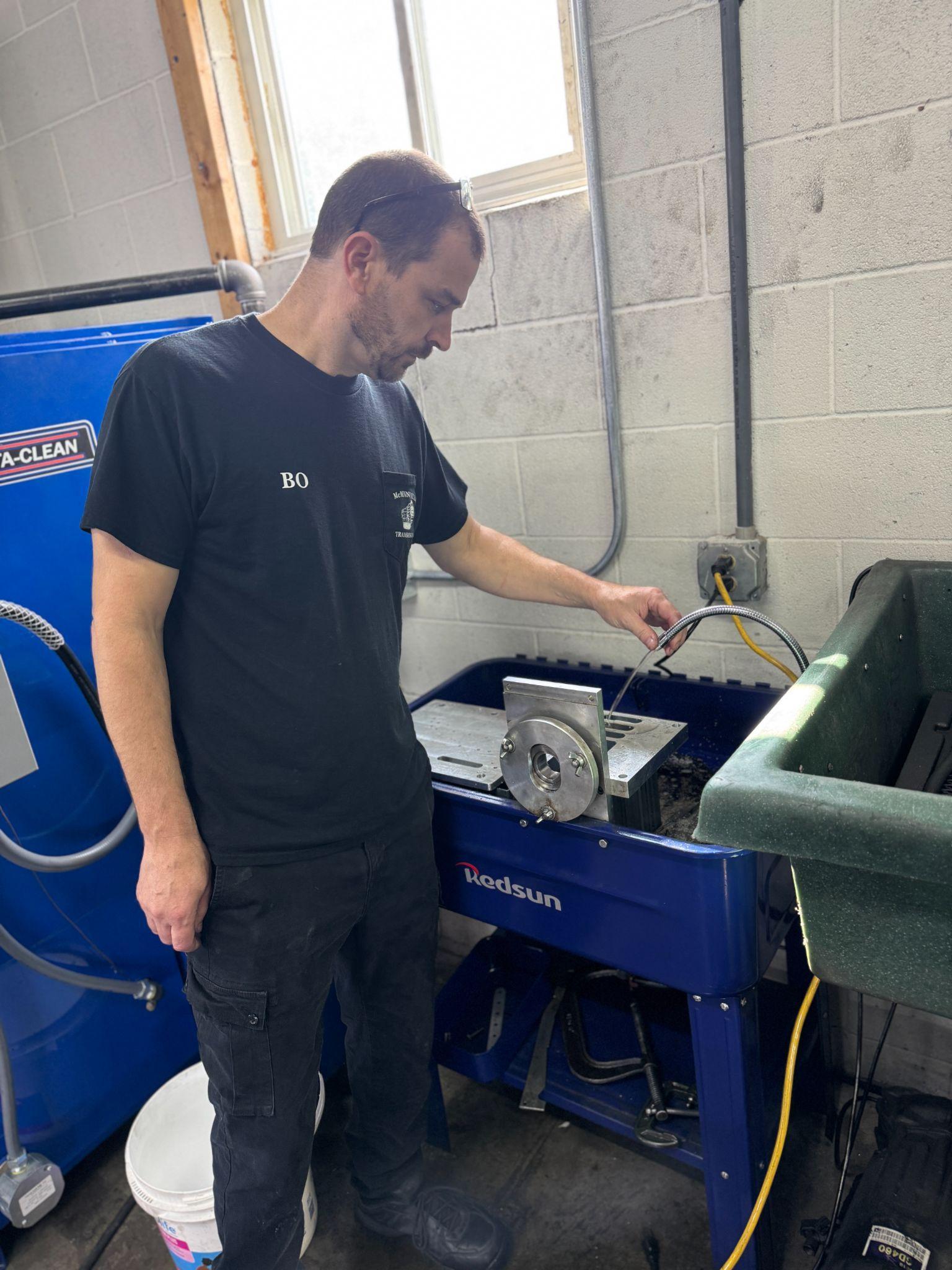
Today, Bo personally diagnoses and rebuilds transmissions. His cousin Jeff Kemper has more than 20 years of experience with removal, installation, scanning, and test drives. Bo's nephew Seth Cantrell is learning newer 6-speed, 8-speed, and 10-speed transmission rebuilding, while Connie McCracken helps customers in the front office.
Read more about the family on our About Us / Our Story page.
How Much Does Drivetrain Repair Cost?
The cost of drivetrain repair depends on the component involved, the vehicle's design, the extent of the damage, and the parts and labor required.
Replacing a CV axle is different from repairing a differential. A U-joint concern may involve different work from a driveshaft problem, and an internal rear-end failure may require more extensive disassembly and repair.
The first step is identifying the cause so the repair options can be discussed. Rather than advertising one price for every drivetrain problem, we want customers to understand what needs attention and why.
Schedule Drivetrain Service in McMinnville, TN
If your car or truck is clunking, clicking, vibrating, or making an unfamiliar noise, contact McMinnville Transmission to discuss the problem.
We're located at 1703 S. Chancery St., McMinnville, TN 37110, serving drivers from McMinnville and Warren County, as well as nearby Smithville, Sparta, Woodbury, Manchester, and surrounding communities.
Call (931) 473-5302 with your vehicle's year, make, model, and symptoms. Tell us whether the noise or vibration occurs during acceleration, turning, braking, or shifting between drive and reverse.
You can also visit Contact & Directions or explore our complete Transmission Services.