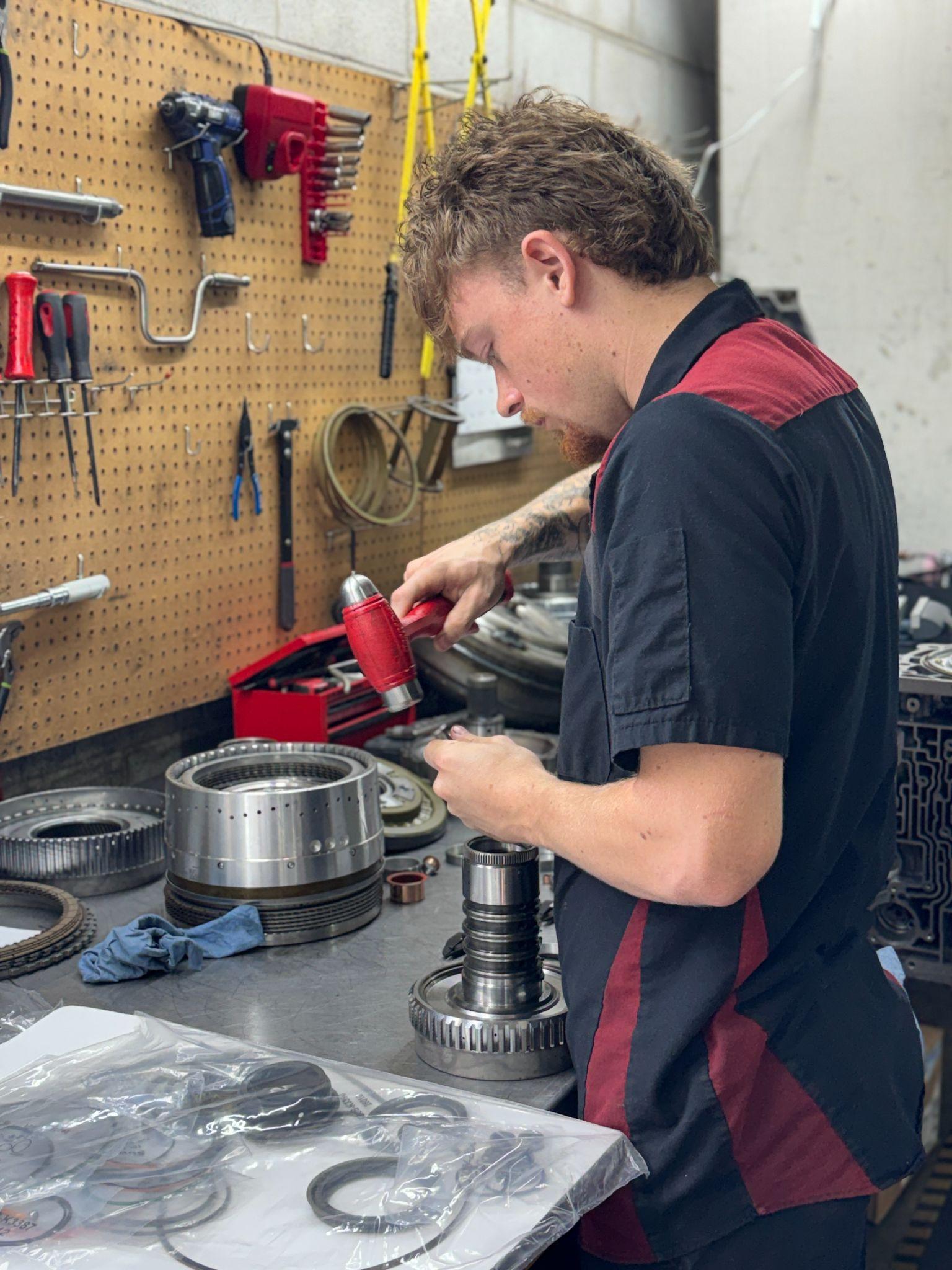
At McMinnville Transmission, owner Bo McCracken personally diagnoses and rebuilds transmissions. His family has worked in the transmission business since 1976, and the shop has served McMinnville since 1979. We work on certain CVT-equipped vehicles, including appropriate Nissan models, but not every CVT can be repaired or rebuilt in-house.
Our goal is to help you understand what is happening with your vehicle before recommending a major repair. Call (931) 473-5302 with your vehicle's year, make, model, and symptoms so we can discuss whether your CVT is one we service.
What Makes a CVT Different From a Regular Automatic Transmission?
A conventional automatic transmission typically uses a series of fixed gear ratios. As you accelerate, the transmission shifts from one gear to another, and you can often feel those gear changes.
A continuously variable transmission works differently. Many CVTs use a system of variable-diameter pulleys and a steel belt or chain to change the transmission ratio smoothly, without the same sequence of fixed gear changes. Other CVT designs operate differently, which is one reason identifying the exact transmission matters.
This allows the engine to operate at different speeds while the transmission adjusts its ratio to match driving conditions. Some CVT-equipped vehicles are programmed to simulate traditional gear changes, but that does not make their internal construction the same as a conventional automatic.
Because the design is different, CVT problems can require different diagnostic methods, specialized components, and different repair decisions. A symptom that seems like a slipping conventional automatic transmission may have a different explanation in a CVT.
Learn more about conventional transmissions on our Automatic Transmission Repair page.
Common Signs of CVT Transmission Problems
Shuddering or Jerking During Acceleration
One complaint drivers report is a shuddering sensation when accelerating from a stop or maintaining a steady speed. It may feel like a vibration, repeated hesitation, or an uneven transfer of power.
The cause may involve transmission operation, hydraulic pressure, internal wear, or another vehicle system. Shuddering is a symptom, not a diagnosis, and it should be evaluated before assuming the CVT needs replacement.
Hesitation or Delayed Response
Does your vehicle pause before responding when you press the accelerator? Does it hesitate when you shift into drive or reverse?
Delayed engagement and hesitation can have several possible causes, including transmission control problems, pressure concerns, or internal mechanical damage. The conditions under which the hesitation occurs can help narrow down the possibilities.
Unusual Engine RPM Behavior
CVTs do not always sound or feel like conventional automatic transmissions. In some situations, it is normal for engine speed to remain relatively steady while the vehicle accelerates, or for engine RPM to change differently than drivers expect.
However, excessive revving, an unexpected loss of acceleration, or a noticeable change from the vehicle's usual behavior may indicate a problem. Understanding the difference between normal CVT operation and an actual malfunction is an important part of diagnosis.
Whining, Humming, or Unusual Noises
A whining or humming sound that changes with vehicle speed or acceleration may be associated with transmission components, bearings, hydraulic operation, or other drivetrain systems.
The location, timing, and conditions of the noise matter. Not every noise heard while driving originates inside the CVT.
Warning Lights or Reduced Performance
A check engine light, transmission warning, or reduced-performance condition may indicate that the vehicle has detected an operating problem. Some vehicles limit transmission operation to help protect components when certain faults occur.
A trouble code can help direct testing, but it does not automatically identify the failed part. Our Transmission Electrical & Solenoid Diagnostics page explains why electronic transmission concerns require more than simply reading a code.
Nissan CVT Transmission Repair
Nissan vehicles are among the most familiar examples of passenger cars and SUVs equipped with CVT transmissions.
Depending on the model year, engine, and configuration, Nissan Altima, Rogue, Sentra, and Versa vehicles have used several Jatco CVT designs.
Examples include:
- JF011E (RE0F10A): A CVT family used in certain Nissan vehicles.
- JF015E (RE0F11A): A compact CVT design used in certain smaller Nissan models.
- JF016E (RE0F10D): Another Jatco CVT family found in particular Nissan vehicles.
These transmission codes are important because the internal design, electronic controls, available parts, and repair options may differ. A Nissan Rogue and a Nissan Sentra do not necessarily have the same CVT, even when both vehicles have similar symptoms.
We also discuss appropriate Honda, Mazda, and Mitsubishi vehicles based on their specific transmission designs. Not every vehicle from these manufacturers has a CVT, and not every CVT is one our shop can repair.
The codes above identify real transmission families, not a promise that McMinnville Transmission services every vehicle equipped with them. We confirm the exact vehicle and transmission before discussing available work.
Why Proper CVT Diagnosis Matters
When a CVT begins slipping, shuddering, or hesitating, it is understandable to worry that the entire transmission has failed. However, replacing a transmission without identifying the cause can be an expensive assumption.
Depending on the vehicle and symptoms, evaluation may include discussing when the problem occurs, reviewing available diagnostic trouble codes and operating information, checking for visible leaks, assessing fluid condition where appropriate, and considering additional testing.
A problem involving a sensor, control system, hydraulic operation, or internal mechanical component may create overlapping symptoms. In some cases, a repair outside the transmission itself may be needed.
Bo's approach to diagnosis reflects something his father, Chuck McCracken, taught him years ago:
“Don't tell somebody they need a transmission unless you're sure they need a transmission.”
That philosophy is particularly relevant when a customer has already been told that a CVT must be replaced based only on a warning light or driving symptom.
Our Transmission Diagnostics page explains how the shop approaches finding the cause before choosing a repair.
CVT Fluid Service: Why the Correct Fluid Matters
CVT transmissions have specific fluid requirements. The fluid must support the transmission's design, hydraulic operation, lubrication, and the friction characteristics required by its components.
Using an incorrect fluid can affect transmission operation and may contribute to damage. Different CVT designs may require different manufacturer-specified fluids, so the correct specification must be identified for the vehicle.
Fluid condition and maintenance history can be useful information, but changing the fluid is not a guaranteed solution for a CVT that is already slipping or has internal damage.
McMinnville Transmission performs appropriate pan-drop fluid services, including filter and gasket work where applicable. We do not perform machine transmission flushes. Not every CVT has the same service arrangement, so call to discuss whether fluid service is appropriate for your specific transmission.
Learn more on our Transmission Fluid Service page.
Can a CVT Transmission Be Repaired or Rebuilt?
This is one of the most important questions a CVT owner can ask, and the answer depends on the transmission.
Some CVT problems may be addressed through a targeted repair, depending on the fault and the parts available. Other problems involve internal damage that makes repair more complicated or impractical.
Unlike many conventional automatic transmissions, some CVT designs have limited internal service options or parts availability. That can affect whether rebuilding is a reasonable choice.
McMinnville Transmission performs in-house transmission rebuilding, but we do not promise that every CVT can be rebuilt. The decision depends on the exact transmission, its condition, and the available repair options.
Our Transmission Rebuilding page explains how in-house rebuilding differs from replacing a complete unit.
When Is CVT Transmission Replacement Necessary?
If a CVT has significant internal damage or cannot be repaired appropriately, replacement may be the practical option.
However, replacement introduces its own considerations. The correct transmission must match the vehicle, and electronic controls, components, and any vehicle-specific setup requirements must be considered.
Depending on availability and the vehicle, replacement options may include a remanufactured transmission, another suitable replacement unit, or a used transmission. Each option has different considerations involving condition, compatibility, cost, and warranty coverage.
A used CVT may have an uncertain service history or unknown internal wear. Before purchasing one yourself, talk with the shop about whether it can be accepted for installation and what warranty terms, if any, would apply.
Learn more about these decisions on our Transmission Replacement page.
Three Generations of Transmission Knowledge
McMinnville Transmission's experience comes from a family that has spent decades working with transmissions as the vehicles themselves have changed.
Charlie Cooper helped teach Chuck McCracken the trade. Chuck opened his shop in Smithville in 1976 and moved the business to McMinnville in 1979. His son Bo joined the business in 1997 and took over daily operations when Chuck became seriously ill in 2002.
Even while Chuck was in the hospital, Bo sometimes called him to discuss difficult transmission problems. Chuck passed away in 2004, but his knowledge and approach to careful diagnosis continued through Bo.
Today, Bo personally diagnoses and rebuilds transmissions. His cousin Jeff Kemper has more than 20 years of experience with transmission removal, installation, scanning, and test drives. Bo's nephew Seth Cantrell is learning to rebuild newer 6-speed, 8-speed, and 10-speed automatic transmissions under Bo's guidance, while Connie McCracken continues helping customers in the front office.
CVTs are one example of how transmission technology continues to change. The shop's experience with mechanical transmission systems, combined with its attention to newer designs, helps guide conversations about what is practical for each vehicle.
Read more about the family on our About Us / Our Story page.
How Much Does CVT Transmission Repair Cost?
There is no single price that accurately represents every CVT repair. The cost depends on the transmission, the cause of the problem, available parts, and whether a targeted repair or replacement is appropriate.
A fluid-related concern, an electronic problem, and major internal damage are very different situations. Before deciding on a repair, it is important to understand what work is being recommended and why.
Certain qualifying work may include a 24-month/24,000-mile warranty, subject to the written terms for the specific job. Coverage is not automatic for every CVT repair, replacement unit, or customer-supplied part.
See our Transmission Warranty page for more information.
Talk With McMinnville Transmission About Your CVT
If your Nissan or another CVT-equipped vehicle is shuddering, hesitating, making unusual noises, or behaving differently than normal, give us a call.
McMinnville Transmission is located at 1703 S. Chancery St., McMinnville, TN 37110. We speak with drivers from McMinnville and Warren County, as well as nearby Smithville, Sparta, Woodbury, Manchester, and surrounding communities.
Call (931) 473-5302 with your vehicle's year, make, model, and symptoms. If you have already received a diagnosis or know the transmission code, that information can help us discuss your options.
Visit Contact & Directions for the shop location or explore our complete Transmission Services.