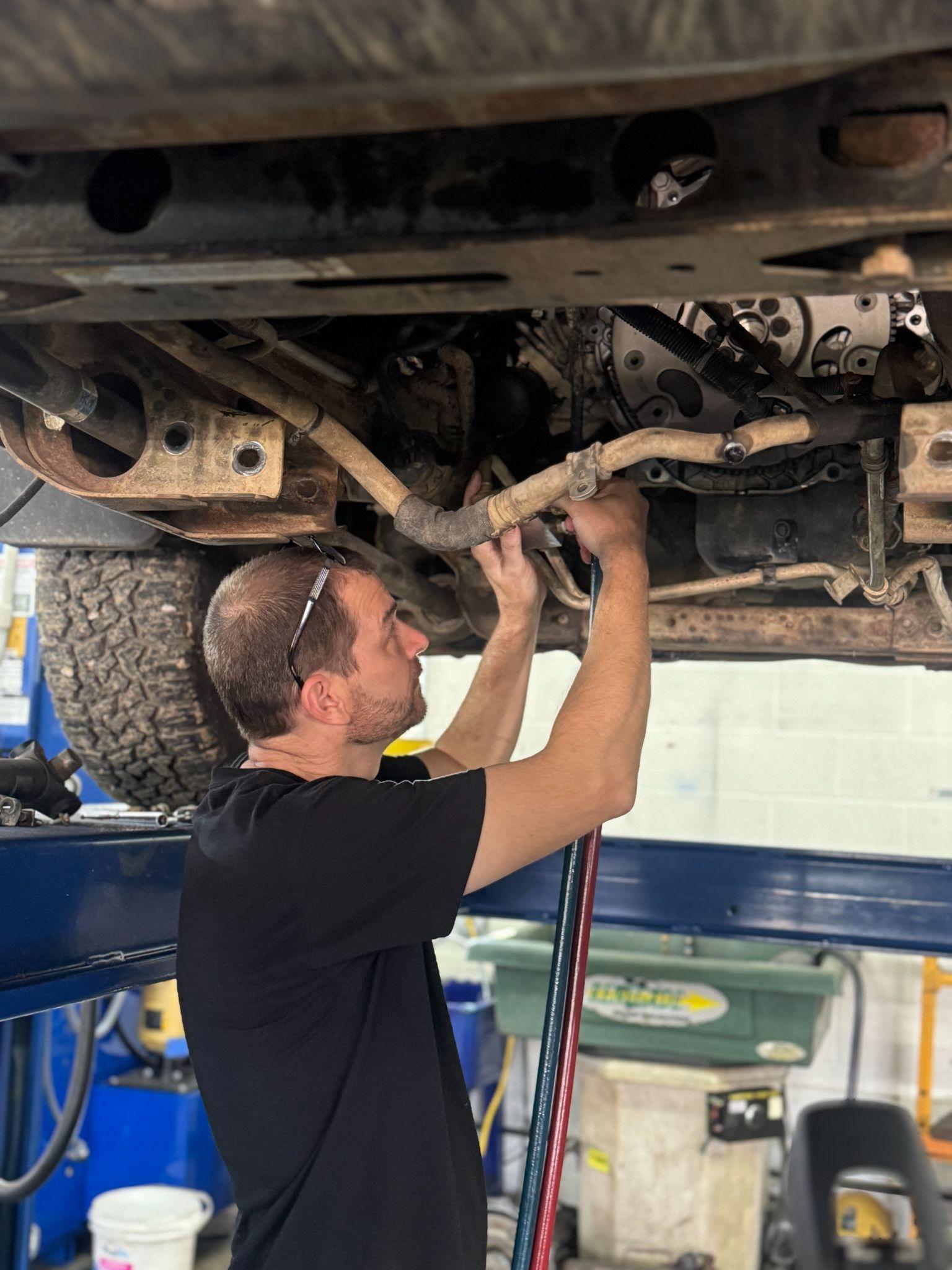
Owner Bo McCracken personally diagnoses and rebuilds transmissions, continuing a family trade that began in 1976. The shop has served McMinnville since 1979, helping drivers understand transmission problems and make informed repair decisions.
If you suspect your transmission is leaking, call (931) 473-5302 and tell us what you've noticed. We'll discuss the appropriate next step for your vehicle.
How Do You Know If Your Transmission Is Leaking?
A puddle beneath your vehicle is often the first thing that gets your attention, but not every transmission leak leaves an obvious spot on the driveway. Some leaks develop gradually, and fluid may collect on surrounding components or spread underneath the vehicle while driving.
Transmission fluid can vary in color depending on the type, age, and condition of the fluid. Some fluids are red or reddish-brown, while others may be amber, greenish, or another color. Because engine oil, power steering fluid, coolant, and other automotive fluids can also leak, color alone is not a reliable way to identify a transmission leak.
Other warning signs may include delayed engagement when shifting into drive or reverse, unusual shifting behavior, slipping, or a whining noise. These symptoms can have several causes, but low transmission fluid is one possibility that deserves attention.
If your vehicle is slipping severely, losing movement, or showing signs of a significant fluid leak, avoid continuing to drive it. Operating a transmission with insufficient fluid can lead to more serious damage.
Common Places Transmission Fluid Leaks Develop
The location of a leak depends on the transmission's design, the condition of its components, and how the vehicle is used. Finding the actual source is important because fluid can travel along the transmission case or other parts before dripping onto the ground.
Transmission Pan Gasket Leaks
Many conventional automatic transmissions have a removable pan on the lower portion of the transmission. The pan provides access to certain internal components and, on some transmissions, a serviceable filter.
A gasket or sealing surface problem can allow fluid to escape around the pan. However, fluid found near the pan doesn't always mean the pan gasket has failed. A leak from higher on the transmission may run downward and make the pan appear to be the source.
When a pan gasket is responsible, the appropriate repair depends on the transmission design and the condition of the sealing surfaces. Our Transmission Fluid Service page explains pan removal, filter replacement, and gasket service where applicable.
Transmission Input and Output Seal Leaks
Transmissions use seals at various locations to help retain fluid around rotating components. Depending on the design, these may include seals near the transmission input, output shaft, axle connections, or other areas.
When a seal wears or becomes damaged, fluid may begin escaping. The repair can vary considerably depending on the seal's location. Some seals are relatively accessible, while others may require significant disassembly or transmission removal.
It's also important to consider why the seal is leaking. A damaged sealing surface, worn supporting component, or another mechanical problem may need attention to help prevent the leak from returning.
Transmission Cooler Line Leaks
Many automatic transmissions circulate fluid through a cooling system to help manage operating temperatures. Depending on the vehicle, the system may include metal lines, hoses, fittings, and connections to a cooler or heat exchanger.
A damaged line, deteriorated connection, or leaking fitting can allow fluid to escape. Some cooler line leaks become more noticeable when the vehicle is operating and fluid is circulating through the system.
A cooler line problem can result in significant fluid loss, so it should not be ignored. The correct repair depends on the location of the leak and the condition of the affected components.
Other Transmission Seals and Connections
Not every leak comes from the pan, a major shaft seal, or a cooler line. Certain transmissions may develop leaks around electrical connectors, case joints, covers, or other sealed components.
Modern transmissions can have complicated case designs and integrated electronic or hydraulic components. That makes it especially important to identify the exact transmission and inspect the suspected leak area before recommending a repair.
Why Driving With Low Transmission Fluid Can Cause Damage
Transmission fluid performs several important jobs. In many automatic transmissions, it helps lubricate internal components, manage heat, and provide hydraulic pressure for clutch engagement and shifting.
When the fluid level becomes too low, the transmission may not operate as designed. Hydraulic pressure problems can affect how clutches engage, and insufficient lubrication or cooling can contribute to internal wear or damage.
The symptoms depend on the transmission and how much fluid has been lost. Some drivers notice delayed engagement or slipping, while others experience harsh shifts, unusual noises, or a loss of movement.
The important thing to understand is that repairing the leak and repairing damage caused by the leak are not necessarily the same job. If the transmission has been driven with insufficient fluid, additional evaluation may be needed to determine whether internal components have been affected.
For shifting or operating concerns, learn more about Transmission Diagnostics.
How We Approach Transmission Leak Diagnosis
Finding a leak begins with understanding what the vehicle is doing. Where have you noticed fluid? Does it appear after the vehicle has been parked overnight, or only after driving? Have you noticed changes in shifting, unusual noises, or warning lights?
Depending on the vehicle and symptoms, evaluating the leak may involve inspecting the transmission and surrounding components, looking for signs of fluid movement, checking accessible connections and sealing areas, and assessing the transmission's operating condition.
Because fluid can travel away from its original source, the wettest or lowest point isn't always where the leak began. Identifying the source helps determine whether the problem involves a gasket, seal, line, fitting, or another component.
If the transmission is also shifting abnormally, the team may need to consider whether fluid loss has affected its operation. Our broader Transmission Repair services address problems that go beyond simply stopping a leak.
Transmission Leaks in Ford, Chevrolet, GMC, Dodge, and Ram Trucks
Pickup trucks and SUVs have used many different automatic transmissions over the years, and their leak locations and repair procedures can vary.
Certain Ford F-150 trucks use the 6R80 6-speed automatic, while newer Ford vehicles may use the 10R80 10-speed automatic. Chevrolet Silverado and GMC Sierra trucks have used transmissions such as the 6L80 6-speed, 8L90 8-speed, and 10L80 10-speed.
Dodge and Ram trucks also have different transmission designs depending on the model and year, including the 68RFE 6-speed, Aisin AS69RC 6-speed, and certain ZF 8-speed transmissions.
These examples help explain why identifying the transmission matters. A leak around one transmission's pan, cooler connections, or case seals may require a different repair procedure from a similar-looking leak on another transmission.
The transmission codes above are examples of units found in these vehicles, not a guarantee that we service every model equipped with them. Call with your vehicle's year, make, model, and transmission information so we can confirm the work we handle.
Transmission Leaks in Nissan, Honda, Mazda, and Mitsubishi Vehicles
We also work on many domestic and Asian vehicles, including appropriate Nissan, Honda, Mazda, and Mitsubishi models. Some use conventional automatic transmissions, while others use continuously variable transmissions, or CVTs.
Certain Nissan Altima, Rogue, Sentra, and Versa vehicles use Jatco CVT families such as JF011E (RE0F10A), JF015E (RE0F11A), and JF016E (RE0F10D). These transmissions have different designs and fluid requirements from many conventional automatics.
A suspected CVT leak should be evaluated with the exact transmission in mind. Incorrect fluid or improper service procedures can create additional problems, and not every CVT has the same repair options.
Read more about these differences on our CVT Transmission Repair page.
McMinnville Transmission works on many domestic and Asian vehicles, but not every model or transmission. We do not service European vehicles.
Will Fixing a Transmission Leak Solve My Shifting Problems?
Sometimes a leak is discovered before the transmission develops noticeable operating problems. In other cases, the driver may already be experiencing slipping, hesitation, or harsh shifting.
If low fluid has affected transmission operation, correcting the leak and addressing the fluid level may be part of the repair. However, fresh fluid and a new seal cannot reverse internal damage that has already occurred.
The transmission may need additional testing to determine whether the problem is limited to fluid loss or involves internal wear, hydraulic problems, or other mechanical concerns.
In more serious situations, Transmission Rebuilding may become part of the discussion. But that decision should follow an evaluation of the transmission, not simply the discovery of a leak.
A Family Transmission Shop That Believes in Finding the Cause
McMinnville Transmission's approach to leak repair comes from decades of working on the inside of transmissions, not just looking at what is visible underneath a vehicle.
Charlie Cooper helped teach Chuck McCracken the transmission trade. Chuck opened his shop in Smithville in 1976 and moved the business to McMinnville in 1979. His son Bo joined the shop in 1997 and took over daily operations when Chuck became seriously ill in 2002.
During that time, Bo sometimes called his father at the hospital to talk through difficult transmission problems. Chuck passed away in 2004, but his approach to careful diagnosis remains part of the shop's work today.
One of Chuck's lessons was simple: “Don't tell somebody they need a transmission unless you're sure they need a transmission.”
That matters when a customer comes in with a fluid leak. A leaking seal doesn't automatically mean the entire transmission needs replacement, just as a wet transmission pan doesn't automatically mean the pan gasket is responsible.
Today, Bo personally diagnoses and rebuilds transmissions. His cousin Jeff Kemper brings more than 20 years of experience with transmission removal, installation, scanning, and test drives. Bo's nephew Seth Cantrell is learning newer 6-speed, 8-speed, and 10-speed transmission rebuilding, while Connie McCracken helps customers in the front office.
Read more about the family on our About Us / Our Story page.
How Much Does Transmission Leak Repair Cost?
The cost of repairing a transmission leak depends on where the fluid is escaping, what parts are involved, and how much work is required to reach the affected area.
A pan gasket repair is different from a leak that requires transmission removal. A cooler line repair may involve different components and labor from replacing a seal near the transmission's input or output.
If the transmission has also developed internal problems from operating with insufficient fluid, the repair may be more involved.
Rather than offering a universal leak repair price, we recommend discussing your vehicle's symptoms and the findings needed to determine the appropriate work. Certain qualifying repairs may include a 24-month/24,000-mile warranty, subject to the actual written terms. See our Transmission Warranty page for more information.
Get Help With a Transmission Leak in McMinnville, TN
If you've noticed fluid beneath your vehicle or suspect your transmission is leaking, don't wait until a small problem becomes a more serious one.
McMinnville Transmission is located at 1703 S. Chancery St., McMinnville, TN 37110. We help drivers from McMinnville and Warren County, as well as nearby communities including Smithville, Sparta, Woodbury, and Manchester.
Call (931) 473-5302 with your vehicle's year, make, model, and symptoms. Tell us where you've noticed fluid, whether the transmission is shifting normally, and whether the vehicle can be driven safely.
For directions, visit Contact & Directions, or explore our complete Transmission Services.