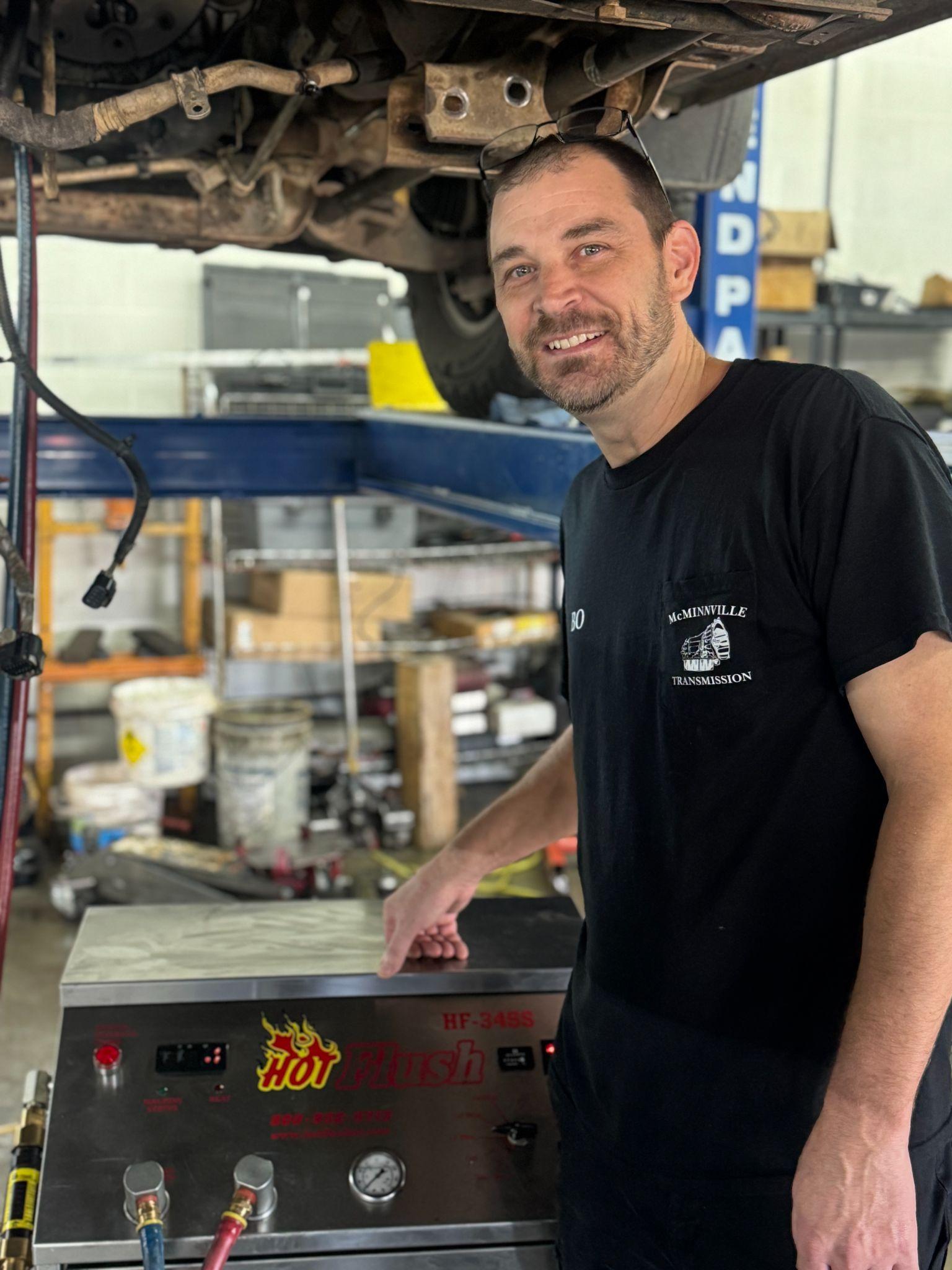
Owner Bo McCracken personally diagnoses and rebuilds transmissions, continuing a family trade that began in 1976. Our shop has served McMinnville since 1979, and we bring that same attention to drivetrain problems involving differentials and rear-end assemblies.
If your car, truck, or SUV is whining, clunking, vibrating, or leaking fluid around the axle, call (931) 473-5302 to discuss your vehicle and the appropriate next step.
What Does a Differential Do?
A differential is a drivetrain component that transfers power to the driving wheels while allowing them to rotate at different speeds during turns. Without that difference in wheel speed, normal cornering would be more difficult and could place unnecessary stress on tires and drivetrain components.
On many rear-wheel-drive trucks and SUVs, the differential is located inside the rear axle housing. Four-wheel-drive vehicles may have both front and rear differentials, while many front-wheel-drive cars have a differential integrated into the transaxle assembly.
Inside a conventional differential are components such as the ring gear, pinion gear, bearings, and differential gears. Some vehicles also use limited-slip or electronically controlled differential designs, which can have additional components and service requirements.
Because these parts operate under load and rely on proper lubrication, wear or damage can produce noise, vibration, or changes in how power is delivered to the wheels.
Common Signs of Differential and Rear-End Problems
Whining or Humming From the Rear of the Vehicle
A whining or humming noise is one of the complaints drivers commonly associate with a failing rear differential. The sound may become more noticeable as road speed increases or change when accelerating or letting off the gas.
Depending on the vehicle and the problem, worn bearings or damaged gear surfaces may contribute to the noise. However, wheel bearings, tires, and other drivetrain components can create similar sounds.
The way the noise changes under load can provide useful information, but it doesn't identify the failed part by itself.
Clunking When Accelerating or Shifting Gears
A clunk when shifting from park into drive or reverse, or when applying and releasing the accelerator, may indicate excess movement somewhere in the drivetrain.
Possible causes include worn U-joints, differential components, driveshaft connections, or other parts. The sound may seem to come from the rear axle even when the actual problem is elsewhere.
Before assuming the rear differential has failed, it's important to consider the connected components. Our U-Joints & Driveline Repair page explains another common source of driveline clunking.
Grinding or Growling Noises
Grinding or growling can indicate a mechanical problem that deserves prompt attention. Depending on the source, damaged bearings, gears, or other rotating components may be involved.
A differential that has lost lubrication or developed significant internal wear may become increasingly noisy. Continuing to operate the vehicle with a serious mechanical problem can lead to additional damage.
If the noise is severe or the vehicle begins behaving abnormally, avoid continued driving until the problem has been evaluated.
Differential Fluid Leaks
Differentials contain lubricant that helps protect gears and bearings during operation. A leak may develop around the pinion seal, axle seals, differential cover, or another sealed area, depending on the design.
You might notice fluid on the axle housing, near a wheel, or on the driveway. However, the location of a drip doesn't always identify where the fluid originated.
Low lubricant levels can contribute to wear and damage, so suspected differential leaks should not be ignored.
Vibration or Unusual Drivetrain Movement
A vibration that changes with road speed or acceleration may involve a differential or another connected drivetrain component. In some situations, wear or damage can create abnormal movement or noise under load.
Driveshafts, U-joints, axle shafts, wheels, and tires can also produce vibrations. Finding the source is important before recommending differential repair.
What Causes a Rear Differential to Fail?
Differential problems can develop from normal wear, lubrication concerns, damaged seals, excessive mechanical stress, or failures involving internal components.
Bearings support rotating parts and help maintain the correct position of the gears. When bearings wear or become damaged, they may create noise and affect gear alignment. The resulting changes can contribute to further wear if the problem continues.
The ring and pinion gears must operate with the correct contact pattern and adjustment. Damage, wear, or improper alignment can create noise and may require specialized repair procedures.
Fluid loss is another concern. Without sufficient lubricant, gears and bearings may experience increased friction and heat, potentially leading to internal damage.
Not every noisy differential has the same failure. Understanding whether the problem involves a bearing, gear set, seal, or another component helps determine the available repair options.
Differential Bearings, Ring and Pinion Gears, and Internal Wear
The ring and pinion gear set changes the direction of power through many rear axle assemblies. The pinion gear receives power from the driveshaft, and the ring gear transfers it through the differential assembly toward the axle shafts.
These gears must be properly positioned and supported by bearings. Excessive wear, damaged bearings, or changes in gear alignment can affect how the components mesh and may create whining or other noises.
Replacing internal differential components is not simply a matter of installing new parts. Certain repairs require careful measurement and adjustment of bearing preload, backlash, and gear contact patterns according to the axle design.
The appropriate work depends on the condition of the differential and the parts available for that particular axle. In some cases, a targeted repair may be practical. In others, more extensive work or replacement of an assembly may need to be considered.
How We Approach Differential Noise Diagnosis
One of the challenges with rear-end problems is that sound travels through the vehicle. A noise that seems to come from the differential may originate from a wheel bearing, driveshaft, U-joint, or another component.
When discussing the problem, we want to know when the noise occurs. Does it become louder during acceleration, quieter when coasting, or more noticeable during turns? Is it a steady hum, a high-pitched whine, or a single clunk when the drivetrain takes up load?
Depending on the vehicle and symptoms, evaluation may involve inspecting relevant drivetrain components, checking for visible leaks or damage, assessing the condition of the differential lubricant where appropriate, and considering additional testing.
The goal is to identify the actual source before recommending major work. Our Drivetrain Services page explains how differential problems overlap with other drivetrain concerns.
Differential Repair vs. Rear-End Replacement
Not every differential problem requires replacing the complete rear axle assembly. Some problems may involve an individual seal, bearing, or other serviceable component.
If the differential has extensive internal damage, the repair may become more involved. The condition of the gears, bearings, housing, and other components helps determine whether repairing the existing assembly is practical.
In some situations, a suitable replacement assembly may be considered. Compatibility matters because axle ratios, mounting arrangements, electronic components, and other specifications can vary even between similar vehicles.
We don't assume that every rear-end noise calls for the same repair. The available options depend on the vehicle and the findings.
Rear-End Repair for Ford, Chevrolet, GMC, Dodge, and Ram Trucks
Rear differentials are especially important in pickup trucks that regularly carry loads, tow trailers, or operate under demanding conditions.
Certain Ford F-150, Ranger, and Expedition vehicles use rear axle assemblies with designs that vary by model year and drivetrain configuration. Chevrolet Silverado and GMC Sierra trucks also use different axle assemblies depending on the vehicle's specifications.
Dodge and Ram trucks have their own range of rear axle designs, including configurations used in light-duty and heavy-duty pickups.
Even two trucks from the same manufacturer may have different axle ratios, differential types, or internal components. That is why we ask for the vehicle's year, make, model, and drivetrain information before discussing repair options.
McMinnville Transmission works on many domestic and Asian vehicles, including appropriate Ford, Chevrolet, GMC, Dodge, Ram, Nissan, Honda, Mazda, and Mitsubishi models. We do not service European vehicles, and not every axle or differential configuration is one we handle.
Front Differentials and Four-Wheel-Drive Vehicles
Four-wheel-drive trucks and SUVs may have both front and rear differentials, along with a transfer case and multiple driveshafts.
A noise or vibration that appears when four-wheel drive is engaged may involve a front differential, transfer case, driveshaft, or another component. The way the vehicle distributes power and the type of four-wheel-drive system both matter when narrowing down the problem.
Some all-wheel-drive vehicles use different drivetrain arrangements, including integrated components and electronically controlled systems. These designs can have service requirements that differ from a conventional rear axle.
If your vehicle has trouble engaging four-wheel drive or makes grinding noises associated with the transfer case, visit our Transfer Case Repair, Rebuild & Replacement page.
Can a Differential Problem Damage Other Drivetrain Components?
Depending on the failure, a damaged differential may affect other connected drivetrain components. Excessive movement, severe mechanical wear, or internal damage can create additional stress within the axle assembly.
A failed bearing or damaged gear may also generate debris that circulates through the differential lubricant. The extent of damage depends on the problem and how long the vehicle has been operated in that condition.
However, not every differential noise means widespread damage has occurred. The condition of the components should be evaluated before determining the repair scope.
A Family Transmission Shop That Understands the Drivetrain
McMinnville Transmission's history began with Charlie Cooper teaching Chuck McCracken the transmission trade. Chuck opened his shop in Smithville in 1976 and moved the business to McMinnville in 1979.
Chuck's son Bo joined the shop in 1997 and took over daily operations when Chuck became seriously ill in 2002. Even while Chuck was in the hospital, Bo sometimes called him to discuss difficult transmission problems. Chuck passed away in 2004, but his approach to careful diagnosis continued through Bo.
One of Chuck's lessons was, “Don't tell somebody they need a transmission unless you're sure they need a transmission.”
That principle matters when a customer comes in with a rear-end noise. A worn U-joint or wheel bearing should not automatically lead to a recommendation for differential replacement, just as a differential problem should not be mistaken for transmission failure.
Today, Bo personally diagnoses and rebuilds transmissions. His cousin Jeff Kemper brings more than 20 years of experience with removal, installation, scanning, and test drives. Bo's nephew Seth Cantrell is learning newer 6-speed, 8-speed, and 10-speed transmission rebuilding, while Connie McCracken helps customers in the front office.
Read more about the family on our About Us / Our Story page.
How Much Does Differential or Rear-End Repair Cost?
The cost depends on the vehicle, the differential design, the source of the problem, and the parts and labor required.
A leaking seal may require different work from a worn bearing or damaged ring and pinion gear set. A differential with extensive internal damage may need a more involved repair or replacement of the assembly.
Before comparing prices, it's important to understand what has actually failed. The appropriate repair should be based on the vehicle's condition rather than assuming every rear-end noise requires a complete replacement.
Schedule Differential & Rear-End Repair in McMinnville, TN
If your truck or SUV is whining, humming, clunking, or making an unfamiliar noise from the rear, contact McMinnville Transmission to discuss the problem.
We're located at 1703 S. Chancery St., McMinnville, TN 37110, serving drivers from McMinnville and Warren County, as well as nearby Smithville, Sparta, Woodbury, Manchester, and surrounding communities.
Call (931) 473-5302 with your vehicle's year, make, model, and symptoms. Tell us whether the noise changes with speed, acceleration, deceleration, or turning.
Visit Contact & Directions for the shop location, or return to our complete Drivetrain Services.