We work on manual transmission and clutch problems in many domestic and Asian cars and trucks. Whether the concern involves the clutch, hydraulic system, shifting components, or the transmission itself, the first step is understanding the problem before deciding on a repair.
Call (931) 473-5302 and tell us what your vehicle is doing.
Signs Your Manual Transmission or Clutch Needs Attention
Manual transmission problems don't always begin with a complete failure. Often, drivers notice changes in how the vehicle feels or responds.
Clutch Slipping When Accelerating
Does your engine speed increase without a matching increase in vehicle speed. That can be a sign that the clutch is slipping rather than transferring engine power effectively. Clutch friction material can wear over time, but slipping can also involve other components or operating conditions. The cause should be identified before deciding what needs replacement.
Difficulty Shifting Into Gear
If your vehicle becomes difficult to shift into first gear, reverse, or another gear, several systems may be involved. Possible concerns include the clutch release system, shift linkage, internal synchronizers, or other transmission components. One useful clue is whether the transmission shifts more easily with the engine turned off than it does with the engine running.
Grinding When Changing Gears
Grinding can occur when gears are not engaging properly. Depending on the symptoms, the problem may involve incomplete clutch disengagement, worn synchronizers, or internal transmission damage. Repeated grinding can contribute to additional wear, so it is worth having the problem evaluated.
Clutch Pedal Feels Different
A clutch pedal that suddenly feels soft, unusually stiff, spongy, or slow to return may indicate a problem with the release mechanism or hydraulic system. Some vehicles use a hydraulic clutch system with a master cylinder and slave cylinder. Others use different operating arrangements The correct repair depends on the vehicle's design and the component that has failed.
Noises When Pressing or Releasing the Clutch
A squeal, rattle, growl, or grinding sound that changes when you press the clutch pedal can provide useful diagnostic information. Release bearings, pilot bearings or bushings, internal transmission bearings, and other components can produce different noises. The timing and conditions of the noise help narrow down where to investigate.
Understanding How a Manual Transmission and Clutch Work Together
A manual transmission and a clutch are closely connected, but they are not the same component The clutch allows the driver to temporarily disconnect engine power from the transmission so gears can be changed. The transmission contains the gears, shafts, bearings, synchronizers, and other components that transfer power through the selected gear ratio. When everything works correctly, the clutch disengages, the driver selects a gear, and power transfers smoothly when the clutch is released.
When something goes wrong, the symptoms can overlap. A worn clutch can make the vehicle feel as though the transmission is slipping. A clutch that doesn't release completely can make gears difficult to select. Worn internal transmission components can cause grinding or noise even when the clutch is functioning correctly. That's why replacing a clutch without understanding the problem isn't always the right answer.
Our Transmission Diagnostics service focuses on finding the cause before choosing the repair.
Clutch Repair and Replacement
The clutch system includes several components that must work together.
Clutch Disc and Pressure Plate
The clutch disc provides friction between the engine and transmission, while the pressure plate helps apply the force needed to transfer power. Over time, clutch friction material can wear. Heat, driving conditions, and mechanical problems can also affect clutch operation.
When clutch replacement is appropriate, the condition of related components should be considered rather than focusing only on the disc.
Flywheel Inspection
The flywheel provides the surface against which the clutch engages. Excessive heat, surface damage, or other problems can affect how the new clutch operates. Some vehicles use a conventional solid flywheel, while others use a dual-mass flywheel. Their construction and service requirements differ.
The appropriate repair depends on the flywheel's condition and the vehicle manufacturer's requirements.
Release Bearing and Clutch Fork
The release bearing and related mechanisms help disengage the clutch when the driver presses the pedal Wear or failure can produce noise, poor release operation, or difficulty shifting.
The design varies by vehicle, and some transmissions use an internal concentric slave cylinder instead of a separate external release arrangement.
Clutch Master and Slave Cylinders
Hydraulic clutch systems use fluid pressure to operate the release mechanism. A leaking or failing master cylinder, slave cylinder, or related hydraulic component can prevent the clutch from disengaging correctly. A hydraulic problem may create symptoms that feel like a damaged transmission even when the internal gears are not the cause.
Manual Transmission Repair Beyond the Clutch
Not every shifting problem is a clutch problem.
Manual transmissions contain internal mechanical parts that can wear, become damaged, or fail.
Synchronizer Problems
Synchronizers help match component speeds during gear changes. When they become worn or damaged, drivers may experience grinding or difficulty selecting a particular gear.
The problem may be more noticeable during certain shifts or at certain engine speeds.
Bearings, Shafts, and Internal Gears
Manual transmissions rely on bearings and shafts to support rotating components and transfer power Worn bearings may create whining, growling, or other noises. Internal gear damage can lead to more serious operating problems.
A diagnosis helps determine whether a focused repair, internal rebuilding, or replacement is appropriate.
Shift Linkage and Related Components
Sometimes the problem is outside the transmission itself. Cables, linkage, bushings, mounts, and related components can affect how the shifter feels and how gears are selected.
These possibilities are worth considering before assuming the transmission must be removed and rebuilt Learn more about our broader Transmission Repair services.
Manual Transmissions in Ford, Chevrolet, Dodge, Ram, and Asian Vehicles
Manual transmissions have been used in everything from compact cars and sports cars to pickups and commercial vehicles. The transmission in a Ford Mustang is not necessarily built like the manual gearbox found in a Ford Ranger or an older Ford truck. Likewise, Chevrolet and GMC trucks, certain Dodge and Ram vehicles, and manual-transmission passenger cars can have very different clutch and gearbox designs.
Among Asian vehicles, models such as the Honda Civic, Honda Accord, Mazda3, and certain Mitsubishi vehicles have been offered with manual transmissions in particular years and configurations.
Even within the same model name, transmission choices can change from one year or engine to another We work on many domestic and Asian vehicles, but not every model or transmission. We do not service European vehicles.
If you know the transmission identification code, tell us when you call. If you don't, the year, make, model, engine, and symptoms are a good starting point.
What About 5-Speed and 6-Speed Manual Transmissions?
The number of forward gears doesn't tell the whole story. A 5-speed manual transmission and a 6-speed manual transmission may have different internal components, synchronizer arrangements, clutch systems, and service requirements. The correct diagnosis depends on the specific transmission and the way the problem occurs. For example, grinding into second gear may require a different investigation from a clutch that slips under acceleration in every gear.
We evaluate the vehicle and transmission rather than assuming that all manual gearboxes have the same repair needs.
When Does a Manual Transmission Need Rebuilding or Replacement?
Some problems can be corrected without rebuilding the complete transmission.
A failed hydraulic component, damaged linkage, or certain clutch problems may be addressed separately from the internal gearbox. However, extensive bearing damage, gear damage, or internal wear may require more significant work.
McMinnville Transmission performs in-house transmission rebuilding, with Bo personally involved in that work. Whether a particular manual transmission can be rebuilt depends on its condition, available components, and the repair options for that unit.
Our Transmission Rebuilding and Transmission Replacement pages explain those choices in more detail.
The McCracken Family's Hands-On Transmission Experience
Transmission work has been part of the McCracken family for generations.
Charlie Cooper helped teach Chuck McCracken the trade. Chuck opened his transmission shop in Smithville in 1976 and moved the business to McMinnville in 1979.
Chuck's son Bo grew up around the shop and joined the business in 1997. When Chuck became seriously ill in 2002, Bo took over daily operations. He sometimes called his father at the hospital to talk through difficult transmission problems. Chuck passed away in 2004, but one piece of advice continues to shape the way Bo approaches transmission repair: “Don't tell somebody they need a transmission unless you're sure they need a transmission.
That philosophy matters with manual transmissions, too. A customer who comes in with grinding gears might need clutch work, a hydraulic repair, or internal transmission repair. Those are different problems with different solutions.
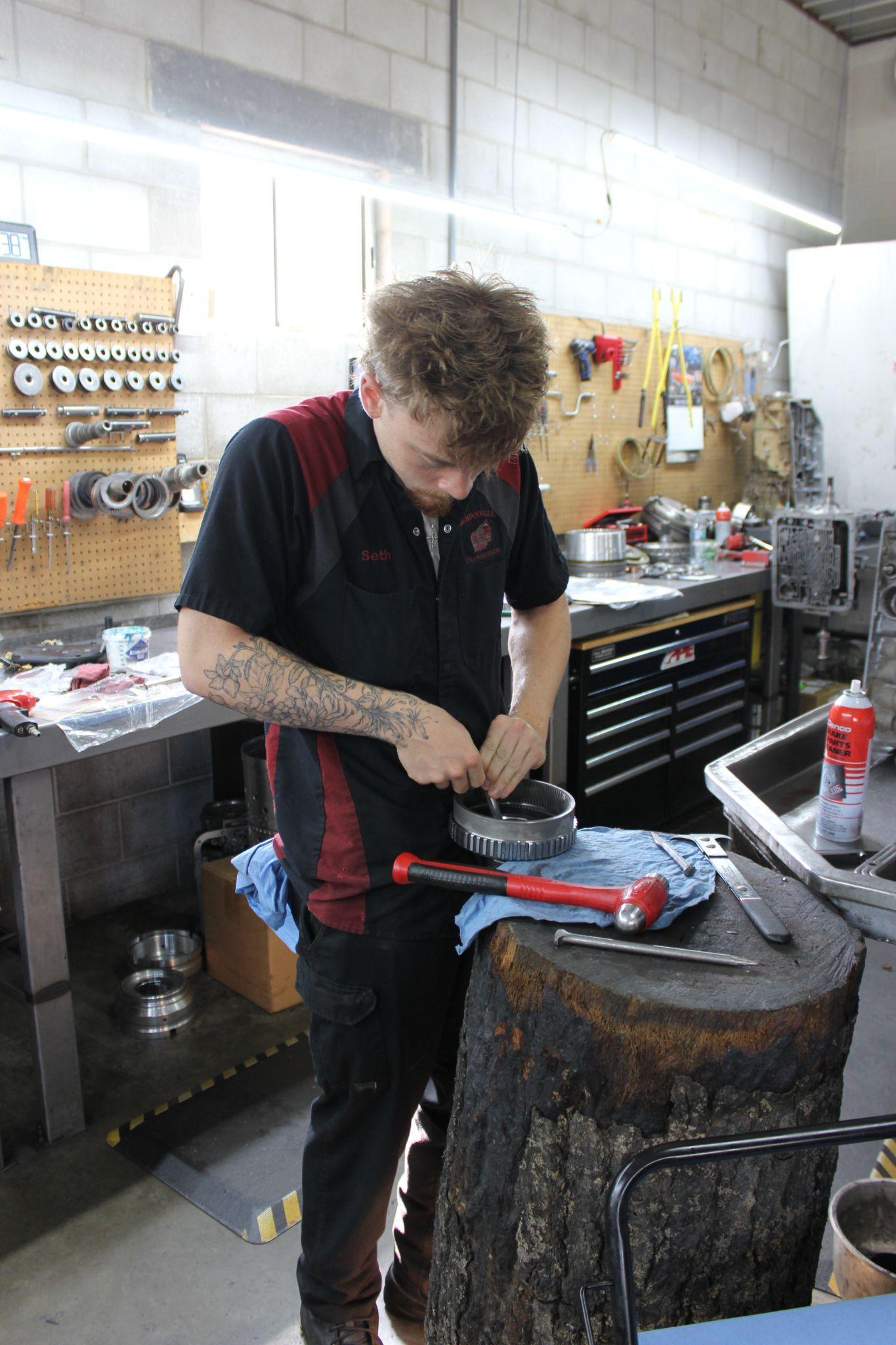
Today, Bo continues diagnosing and rebuilding transmissions himself. His cousin Jeff Kemper has more than 20 years of experience with transmission removal, installation, scanning, and test drives. Bo's nephew Seth Cantrell is learning newer transmission rebuilding techniques under Bo's guidance.
Connie McCracken helps customers in the front office, continuing the family's involvement in the everyday operation of the business.
Read more about their story on our About Us / Our Story page.
Manual Transmission and Clutch Problems in Work Trucks
A manual-transmission work truck can develop clutch and gearbox problems under demanding operating conditions. Frequent starts, heavy loads, and repeated shifting may place additional demands on clutch and transmission components. The correct repair depends on the vehicle, the way it is used, and the condition of the affected parts. We discuss appropriate work trucks and repair options with owners and fleet contacts.
Learn more about Fleet & Work Truck Transmission Repair.
How Much Does Clutch or Manual Transmission Repair Cost?
The cost depends on what has failed and what work is required, A hydraulic clutch repair is different from replacing a clutch assembly. Replacing a clutch is different from disassembling and rebuilding a manual transmission. The vehicle's design, parts availability, labor involved, and condition of related components all affect the repair. We don't advertise a universal clutch replacement price or promise that every job can be completed within the same timeframe.
Ask the shop about the diagnostic process and repair options for your vehicle Certain qualifying work may carry a 24-month/24,000-mile warranty, subject to the actual written terms. Coverage is not automatic for every repair.
Visit Transmission Warranty for more information.
Talk With McMinnville Transmission About Your Clutch or Manual Gearbox
If your clutch is slipping, your vehicle is difficult to shift, or you're hearing grinding noises, don't assume the entire transmission needs replacement. McMinnville Transmission is located at 1703 S. Chancery St., McMinnville, TN 37110. We help drivers from McMinnville, Warren County, and nearby communities including Smithville, Sparta, Woodbury, and Manchester.
Call (931) 473-5302 and tell us your vehicle's year, make, model, and symptoms. You can also visit Contact & Directions or explore our complete Transmission Services.